
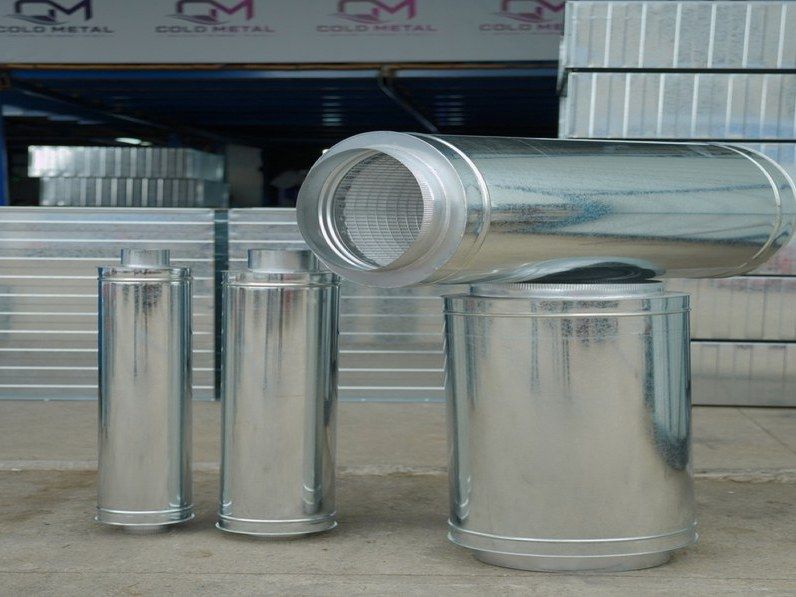
One of the first decisions in a ventilation project is the shape of the ducts. Both options — round spiral and rectangular — are widely used, but they do not suit every situation equally. The choice depends on available space, airflow, noise requirements and installation conditions.
Advantages of round spiral ducts
- Lower pressure loss. Of all shapes with the same area, a circle has the smallest perimeter, so air rubs against less wall. The fan needs less energy for the same airflow.
- Airtightness. A spiral duct is built on one continuous seam and has fewer joints, so less air leaks.
- Rigidity. The spiral seam works as a stiffening rib — the duct is light but strong.
- Fast installation. Fittings push into the duct, and fewer hangers are needed.
- Less noise. A round section has less turbulence and wall vibration.
When rectangular ducts are better
- Limited height. If ceiling space is tight, a rectangular section carries the same air in a low, wide duct. For example, a Ø400 mm round duct is roughly equivalent to a 600×250 mm rectangular section.
- Very high airflow. When the required diameter simply does not fit in the space.
- Connecting to equipment. Air handling units, grilles and many dampers have rectangular connections.
Comparison
| Criterion | Round spiral | Rectangular |
|---|---|---|
| Pressure loss | Lower | Higher (for the same area) |
| Airtightness | High | Depends on joint quality |
| Height required | More | Less |
| Installation | Fast | More labour-intensive |
| Noise | Lower | Large sections may drum |
| Exposed ceilings | Clean, modern look | More technical look |
In practice — often both together
On many projects the main run is rectangular because ceiling space is limited, while the branches to the rooms are round. The two systems are joined with transitions. We make both types and the parts that connect them in one factory, so everything fits together precisely.
Summary
If space allows, a round spiral duct is usually more efficient and quicker to install. Rectangular is the better choice when height is limited or very large airflows must be carried. The final decision belongs to the ventilation design — and we can make either option. Send us your specification and we will send you a price.