
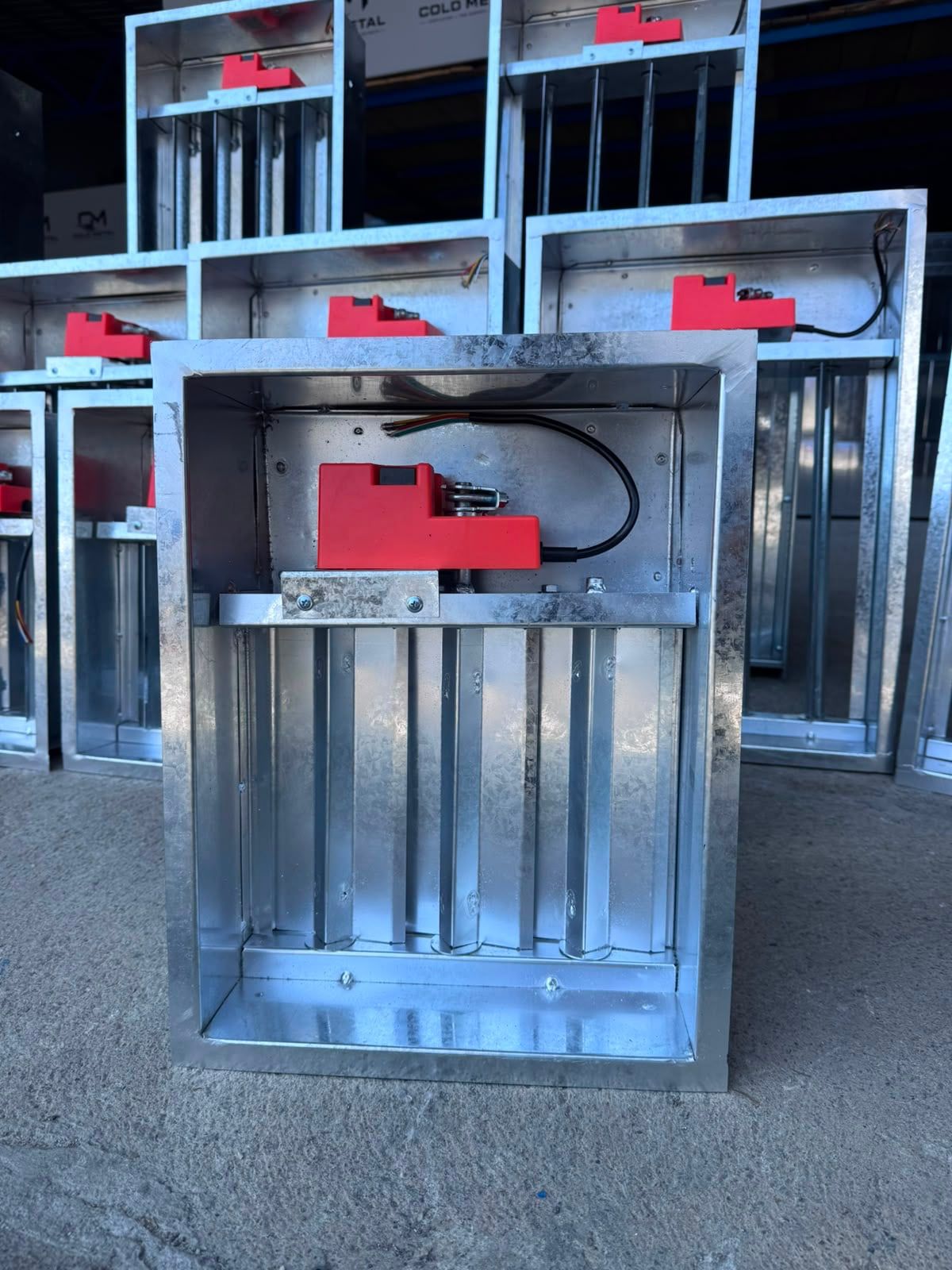
Ducts pass through a building’s walls and floors. In a fire, these same ducts can become the route by which flames and smoke spread to other parts of the building. A fire damper closes that route and restores the integrity of the fire barrier.
How it works
In normal operation the damper is open and air passes freely. In a fire its blade closes. There are two main ways this happens:
- Thermal element — the element breaks at a set temperature (often around 72 °C) and a spring closes the damper;
- Electric actuator — the actuator holds the damper open. On a signal from the fire alarm, or when power is cut, a spring closes it automatically. End switches report the damper position to the fire safety system.
A damper with an electric actuator can be controlled remotely and tested from the building system, which is why modern buildings use them more and more.
What EI 60, EI 90 and EI 120 mean
The fire-resistance class shows how long a closed damper keeps its protective properties:
- E — integrity: flames and hot gases do not pass to the other side;
- I — insulation: the unexposed surface does not heat up beyond the allowed limit;
- the number — minutes: 60, 90 or 120;
- S — if added to the class, smoke leakage is also limited.
In European practice dampers are tested to EN 1366-2 and classified to EN 13501-3. The required class is set by the fire safety design — usually it matches the class of the wall or floor the duct passes through.
Where it is installed
A damper is installed where a duct passes through a fire barrier — a wall or floor. It is important that it is installed the same way it was tested: correct opening, fill and fixing. Access to the damper must also be kept, as it needs regular inspection.
What to consider when choosing
- Shape and size — rectangular or round, to match the duct;
- Fire-resistance class — as per the project;
- Actuator type — thermal or electric, supply voltage;
- Whether it must connect to the fire alarm;
- Installation location and access for maintenance.
Dampers and fire-rated ducts
In smoke extraction systems the duct itself matters as much as the damper — see fire-rated ducts. We make dampers in rectangular and round versions, sized to your duct. Request a quote — include the sizes and the class required by the project.